
UX Design Internship
Design an interactive kiosk platform
that helps both shoppers and retailers in alcohol industry
(Protected by NDA)


I Own
Kiosk UX/UI Design
UX Research
Market Analysis
Cold User Interviews
Teammates
CEO
UX Lead
Head of Product
Developers
Tools
InVision
Sketch
Adobe Illustrator
Adobe Photoshop
Timeline
May 2019 - July 2019
3 months
OVERVIEW
For Summer 2019, I was grateful enough to work on a very unique product with a Los Angeles Hardware-as-a-service startup - Soda Labs. It's an interactive alcohol advertisement kiosk that helps both alcohol retailers to increase sales and alcohol shoppers to purchase products. My job was to conduct market research of the alcohol retail industry, recruit and interview users, synthesize research findings, identify target users, and in the end, develop ideas of the kiosk interactive prototype.
This is a job that enabled me to work with ownership, ambiguity and limited resources. It pushed me to adapt to the fast-moving pace. I had an opportunity to solve challenges that would not usually happen in big companies, deal with changes that happened unexpectedly and came up with solutions and guidance which would directly impact the company.
(*Unfortunately, I cannot share the details of my work since it is still ongoing and is protected by a non-disclosure agreement, but you may find below an overview of our design process and how my work was structured. Please contact me to learn more!)
PROBLEM STATEMENT
The company's business team had identified an opportunity to connect three tiers in the alcohol industry -- alcohol distributors' marketing team, alcohol off-premise retailers (eg. liquor stores) and alcohol shoppers in store -- by creating interactive advertisement kiosk. We knew there was a clear ROI for brands but we were unsure about what ideal value proposition we should have, and what interactive experience we should create to better serve our users -- retailers and shoppers.
WORK TIMELINE

Week 1: Discover
To kick off my internship, I first talked with key stakeholders, and went through all product related documents to understand business model and currently where we are. I also synthesized a comparative report to identify some helpful ideas in the digital display market, which are relate to our product and understand what’s available in the market.
It’s very helpful to know the business model we are running and be aware of the essentially nutrition that support our business. So later on, while I’m designing for users, I’m also aware of the business.

Stakeholder meetings + Synthesize report
Week 2: Background Research + UX Plan
In the second week, I started doing secondary research to understand shoppers' purchasing behaviour and deciding factors, as well as retailers' pain points. I summarized helpful findings of shoppers purchasing and presented to the design team. It was critical to learn as much as we could and narrow down the scope before diving into the user research.
Based on my finding, the lead and I created detailed user research plan based on information/assumptions we had and unanswered questions. Our research goal is to define personas, pain points, and content preference for users - shoppers and retailers.

14 Related Sources

Synthesized Report

UX Plan
Week 3-5: Survey + Cold/Warm User Interviews + PRD
In order to confirm my hypothesis and fill in missing information, we decided to do more qualitative user research.
Because our target users - retailers and shoppers - were two very different user groups, we had to take different approaches in how we interviewed them.
For shoppers, we decided to conduct a shoppers survey. It helped us to confirm the main pain points of shoppers, narrow down the characteristics of our target market, and figure out specific experiences we can improve for in-store purchases. We received over 100 responses in less than 5 days.


Survey
Detailed Documentation on Survey Goals
To understand retailers, we conducted 7 in-person interviews. What's untypical about these user interviews is that we have to recruit and convince target users to interview with us, since our early startup has limited resources and connections with users.
We searched for target alcohol retailers in LA on Yelp and Google, created a color-coded retailers’ interview map, and prepared the kiosk one-pager for the pitch.

Cold retailers-interview map for a day trip
It was a great opportunity of for me to practice cold reaching out to users and doing the elevator pitch. I need to clearly communicate in 30 sec of who we are, what we want, and what you can get if you interview with us. The pitch worked well as 4 out of 9 retailers we cold reached out to scheduled interview with us.
In startup, there's no work as "not my job". While I was doing UX research, my lead and I also worked on the Product Requirement Document. Coming from a software engineering background, I have a good sense of how the data tracking would help measure a product success. Therefore, I took the initiative to define useful data to track on user engagement, retention and conversion.
Week 6: Recruit Users via Cold Emailing
The more deep we get into the research, the more we realized our user group is more diverse than we thought. Therefore, we start reaching out to retailers in a wider scope - outside of LA. It's challenging to mass searching retailers online, but we eventually collected over 200 cleaned online retailer contacts and reach out via cold emailing.


Retailers Email Template
Retailers Contacts List
Week 6 - 8: Ideation + Prototyping + Test
Time is money. We can't wait to perfectly know our users. While we are recruiting users to interview, we started identifying featured content and designing prototypes. Therefore, based on insights we draw from previous research, we had multiple brainstorm sessions, prioritized ideas, and designed 10 level 1 content hi-fi mockup and tested with real shoppers.
Multiple brainstorm sessions of
what content/features user would prefer
based on insights from research.

Prioritize content that would align with potential end-user value and business impact.

*We had to make these relatively quickly due to time constraints. We went for hi-fidelity rather than low-fi because of the particular hypotheses we were trying to confirm.
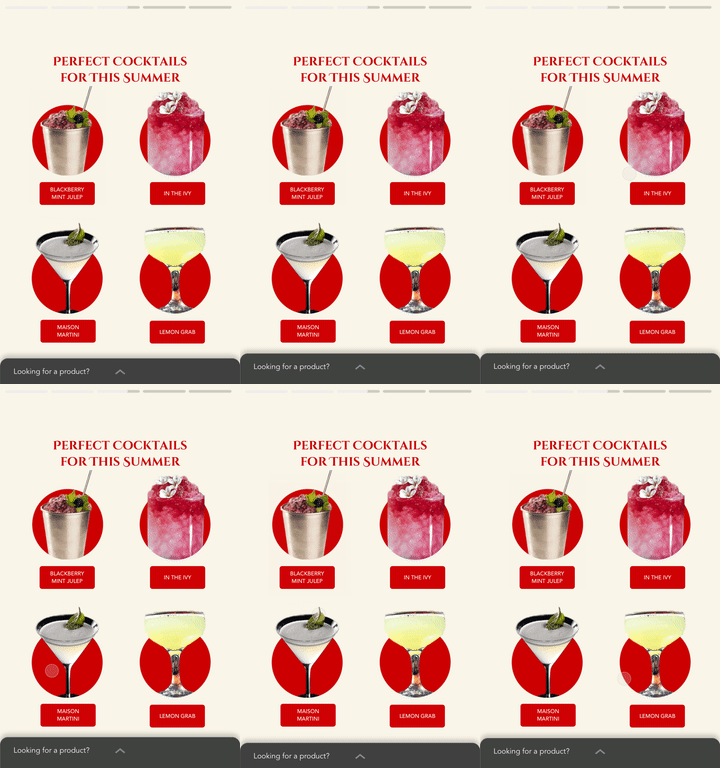
Hi-fi level 1 content mockup for user testing

Narrow down
Prototyping
Week 9 - 10: Generate User Profiles + Design
At the final stage of my internship, while I was designing with UI designers, I synthesized all findings from first and secondary research and presented to the whole company. I came up with the target user profiles -- their characteristics and needs. I also delivered actionable recommendations of how to move forward. The presentation was well received and directly guided company's product development.

Final Presentation Deck
TAKEAWAYS
1. Be able to wear multiple hats
As a team member in a startup, sometimes I need to do non-typical UX work. I need to recruit users, cold reach out to them either via email or in person and convince them to conduct interviews with us. I need to do market research to figure out user profiles in the alcohol industry. I need to write PRD that developers would refer to. The experience of wearing multiple hats equipped me with not only skills that not all designers would have, but also the ability to work outside of my comfort zone.
Most importantly, the results turns out pretty well. I made impactful contribution to the product development in my short period of internship.

CEO's Comments about My Work
2. Research with limited resource
I learned and grew the most when it came to actual research for the start-up. I now know how to test products and prototypes quickly with limited resources, and come up with actionable recommendations for the company. I’m also more aware of possible bias each research method would have and how to eliminate bias as much as possible.
3. Design for users, also for business
Design for users while keeping business in mind. I believe there are two essential nutritions to grow a successful product -- the user-friendly features and stakeholders support. While I’m understanding users’ goal, I also need to find ways to align stakeholders’ goal. Therefore, many of my research recommendations satisfy both users’ and stakeholders need.

4. Contribute not only the work, but also the spirit
There're highs and lows while working for the fast-pacing startup. That's why share a positive spirits is extremely critical. By the end of my internship, many of my colleagues from different roles said that my good energy and comforting nature positively impacted them. It was awesome that I was not only contributing good work, but also good spirit.
"
You have good energy and comforting/positive nature and I would love to see you keep growing and maintaining that trait.
"
- Jesse, the Head of Product


